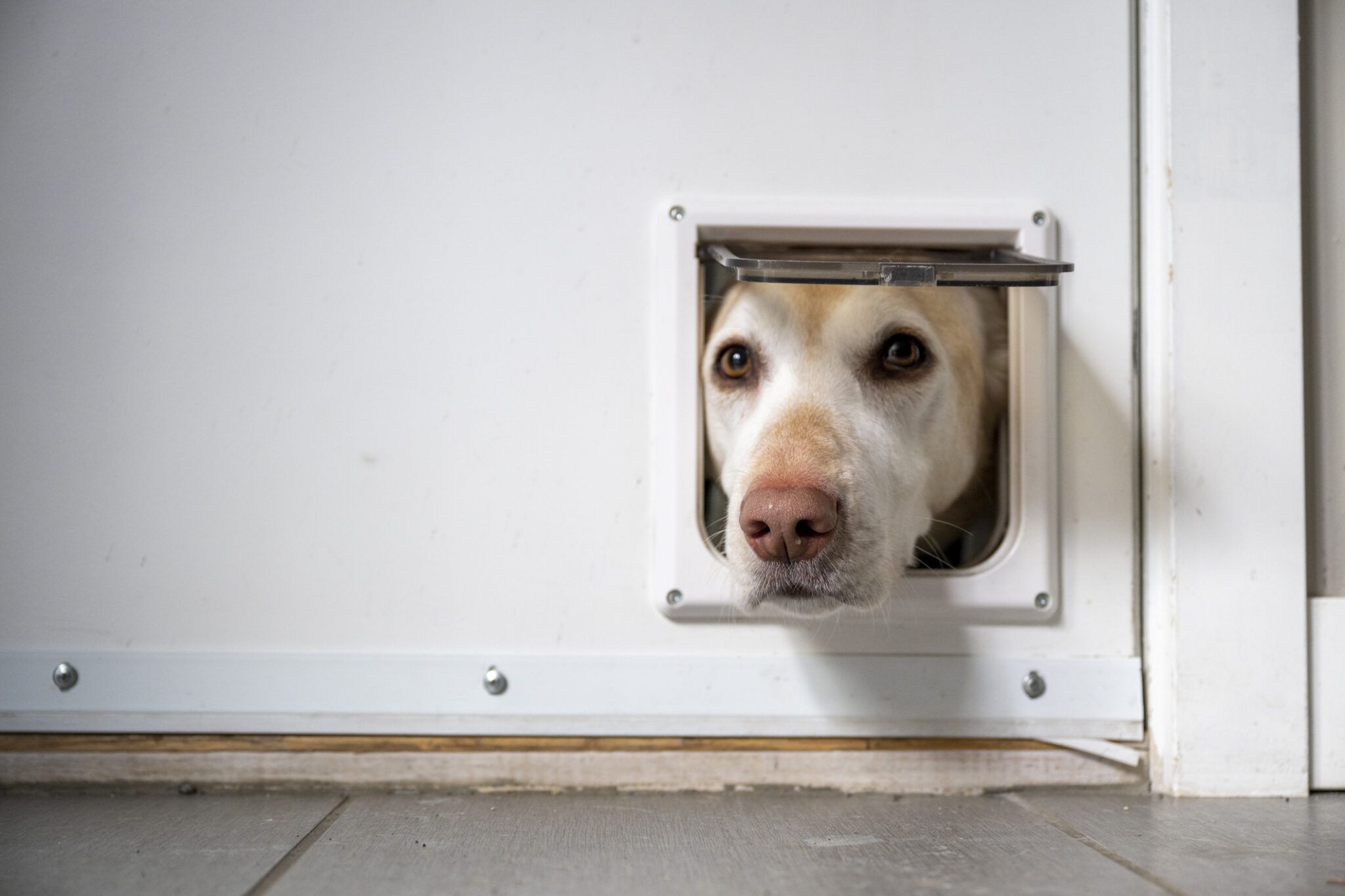
As our homes have become smarter, so has the humble push dog door. Today’s smart dog doors are no longer simple holes in a wall or a door covered with thick rubber. Rather, they are sophisticated access-control systems that combine advanced home security and safety. They can stop neighbor’s dogs, raccoons, and determined thieves from entering your home via your doggie smart door. They can be aesthetically pleasing to your home’s environment as well. But there’s not a one-size-fits-all option.
Your choice depends heavily on what type of electronic access you want and where you’re going to install the doggy door. The RFID collar Electronic Door from PlexiDor is our favorite because you can install it in the wall (the easiest place to install), and it operates by reading a tag on your dog’s collar. Easy-peasy, but expensive (comparatively). However, if your outside access point is a sliding glass door, keep looking.
If you’re not into electronics, a magnet door like the Endura Flap Thermo Panel 3e is simple, provided you install it in a sliding glass door.
Start your search by determining the size you need (your dog’s size), the location (door, wall, glass door), and the access type you’re most comfortable with (manual, app-based, push-open rubber, etc.). This purchase requires some self-education, especially with premium models running $2,800 or more.
With this short course on smart doors for doggy access, you’ll be well-equipped to pick the best smart dog door for your home.
What Is a “Smart” Dog Door?
Smart doors rely on technologies such as microchips embedded in our dogs for identification purposes. These ISO-standard microchips are small, electronic chips enclosed in a glass cylinder that is about the same size as a grain of rice, according to the American Veterinary Medical Association (AVMA). Teamed with smart dog doors, the chips eliminate the need for extra collars and ensure the door remains locked for neighborhood cats or curious raccoons, possums, and other creatures of the night.
If your dog isn’t chipped, Bluetooth or radio frequency identification (RFID) tags used for retail and supply-chain tracking attach to a collar to provide an external solution. These are designed to provide a more consistent range, allowing the door to unlatch as the dog approaches rather than waiting for them to press their nose against the flap.
Some doors feature sensors on both sides of the door, allowing you to set specific curfews or exit-only modes — useful if you want your dog to come in for the night but stay inside once they’ve entered.
Types of Smart Dog Doors
Here’s a rundown on the types of smart dog doors:
RFID collar: A radio-frequency identification tag unlocks the door when it detects a digitally paired tag within close range. (See PlexiDor Electronic Door.)
Manual 3-flap: A nonelectronic design that uses three sequential flaps designed to create an insulating air pocket that your dog must push through.
Manual flap: A traditional, low-tech option that has a single flexible plastic flap that relies on gravity and magnets to keep the door shut after a dog passes. (See Endura Flap Thermo Panel 3e and Solo Pet Doors Automatic Door.)
Microchip/app: Leverages your dog’s permanent vet-implanted identification chip to grant access, often paired with an app for remote monitoring and scheduling. (See Sure Petcare Microchip Connect.)
Automatic: A motorized system that detects a signal and physically lifts or slides the door open so the dog can walk through without pushing. (See High Tech Pet Power Pet Patio.)
App-based options include:
- Ultrasonic: Uses high-frequency sound waves emitted from a collar tag to trigger the door. (See High Tech Pet Power Pet WiFi.)
- Motion: Uses infrared or microwave sensors to detect movement near the door, combined with app-based timers to toggle the sensors on or off. (See Wayzn Smart Door 2.)
- UWB tag: Uses ultra-wideband technology for accurate spatial tracking to ensure the door opens only when your dog is facing it and within inches. (See Pawport Smart Pet Door.)
- Bluetooth: Combines Bluetooth connectivity with a smartphone app or digital fob to allow for proximity entry and guest access management. (See PetSafe SmartDoor Connected.)
Safety First for Doggie Doors
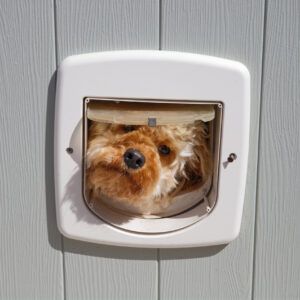
While your temptation may be to replace an existing door with a new intelligent model, placement is a critical factor in both home efficiency and security.
Security experts suggest installing a smart door in a transitional space like a laundry room or a mudroom, which provides an extra layer of insulation and security. This keeps muddy paws (and potential security risks) contained in a secondary area of the home.
Key Decisions Before You Buy a Smart Dog Door
The first decision you need to make is whether to go with an in-door or in-wall unit. In-door models are generally easier for do-it-yourself (DIY) installation but can potentially compromise the structural integrity of the door.
In-wall installations typically require a bit more effort — specifically framing and sealing — but offer a cleaner aesthetic and allow for more flexible placement away from main traffic areas.
Smart doors require a nearby outlet to power the motorized bolts and sensors. While battery backups are standard for power outages, planning for a dedicated power source is a step often overlooked in the planning phase.
Here’s a rundown on installation types:
Door or Wall
- Standard: A unit framed into a standard exterior door or cut directly into a wall using an optional tunnel extension.
- Specialized: These units often include specialized mounting hardware or telescoping tunnels to ensure a flush, weather-tight fit across varying material thicknesses.
- Integrated: Designed to become a permanent part of the home’s structure, often requiring professional framing and siding work for a seamless finish.
- Self-framing: A DIY-friendly option that includes a built-in frame, allowing for straightforward installation without additional carpentry work.
Taking the time to assess your home’s layout, your dog’s size, and the level of technology you’re comfortable managing will go a long way toward finding a smart dog door that works well for both you and your pet.