A Funny-Sounding Word with a Very Serious Meaning
Your female dog is drinking more, panting, lethargic, and you know something just isn’t right. Never ignore that feeling. You know your dog better than anyone else, and if you think something is wrong, it probably is. And if your dog hasn’t been spayed, you could be seeing signs of pyometra: infection of the womb or uterus that can turn deadly if left untreated.
Any dog with a uterus can develop a uterine infection, and, although rare, even dogs that have had a laparoscopic or ‘keyhole’ spay, where only the ovaries are removed, can be at risk of pyometra. So, what is pyometra? Read on to find out.
 Image Credit: Boryana Manzurova, Shutterstock
What Is Pyometra?
An infected uterus or womb, sometimes referred to in practice as a “pyo”, is a relatively common condition affecting entire female dogs. It occurs most commonly in middle-aged to older dogs, but cases have been reported in dogs as young as 9 months.
In dogs, the uterus splits into two branches or ‘horns’ that allow multiple fetuses to be carried on each side. Female dogs come into season or estrus around every six months once they reach sexual maturity. This is when she becomes fertile and receptive to mating. If she becomes pregnant, all being well, she will deliver a litter of puppies approximately 63 days later. Sometimes there can be a ‘phantom’ or ‘false’ pregnancy, also known as pseudopregnancy, where the fluctuating hormones surrounding estrus and mating prepare the dog for pregnancy, even when fertilization hasn’t occurred.
Every time a dog goes through estrus, her cervix relaxes and opens, and the lining of the uterus thickens in preparation for mating and pregnancy. Ordinarily, the cervix helps prevent dirt, debris, and harmful bacteria from entering the uterus, so when the cervix is open, the risk of contamination and infection increases. If fluid and bacteria accumulate, infection can set in over the following 2–3 weeks, resulting in pyometra.
There are two types of pyometra: open and closed.
Open Pyometra
The more common and less dangerous of the two, an open pyometra occurs when there is infection in the uterus, but the cervix remains open. Dogs with an open pyometra are often diagnosed more easily because owners notice a foul-smelling discharge coming from the vulva, or that their dog becomes obsessed with licking her nether regions.
Because the pus can drain out of the uterus, an open pyometra tends to be less of a threat than one that is closed. However, an open pyometra can become closed, and vice versa.
Closed Pyometra
A closed pyometra occurs when the cervix has shut, locking infection inside the body. It is a far more dangerous situation because the problem is not always immediately obvious, and, as the infection continues, pus fills and stretches the uterus. This can bring a risk of septicemia (infection of the bloodstream) and uterine rupture, both of which carry a high risk of mortality.
What Are the Signs of Pyometra?
The signs of pyometra usually appear around 2–3 weeks after estrus. Dogs with an open pyometra may have a yellow, greenish, or brown discharge from the vulva which, if you get close enough to discover, smells pretty awful. However, dogs that are quite clean may lick up any discharge before you notice, so it’s important to be aware of the other signs of pyometra, which include:
Signs of Pyometra
- Increased drinking & urination
- Panting
- Fever
- Reduced appetite
- Vulval discharge
- Licking genitals
- Restlessness
- Lethargy
- Vomiting
- Dark pink or red gums
- Abdominal pain/discomfort
- Weakness/collapse
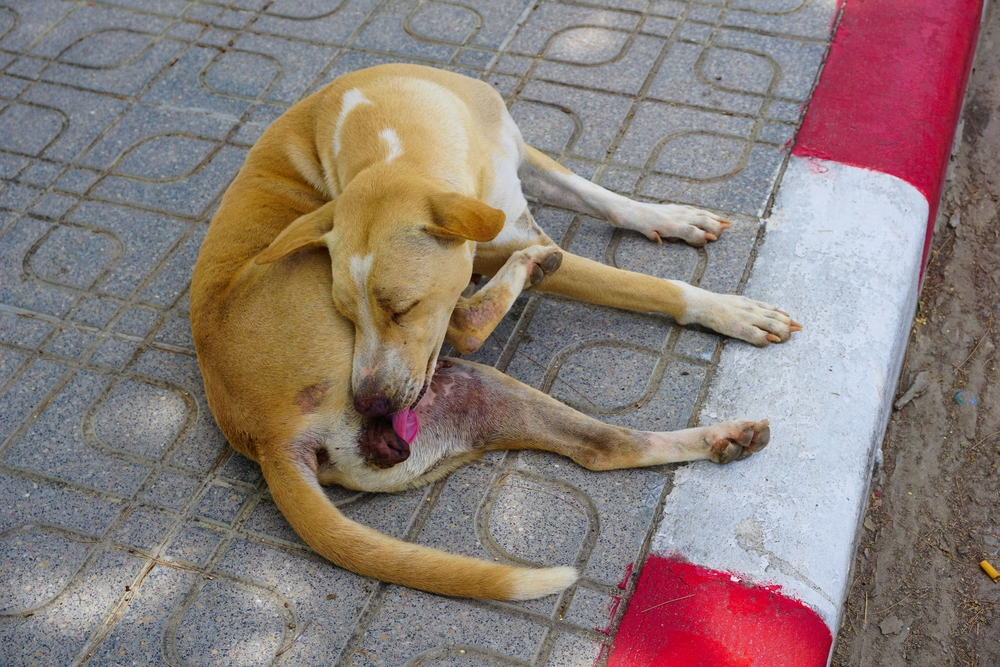 Image Credit: SOORACHET KHEAWHOM, Shutterstock
What Are the Causes of Pyometra?
With each season a dog experiences, her risk of uterine infection increases. At each estrus, the cervix opens, and the repeated thickening of the uterine wall reduces its ability to contract and expel fluid and contaminants. Dogs over 7 years old are typically at higher risk, but pyometra can affect even young dogs.
The most common bacteria involved in pyometra is Escherichia coli (E. coli), responsible for around 90% of cases, usually from fecal contamination.¹ Obesity, recessed vulvas, chronic diarrhea, and thick coats that regularly become soiled increase the incidence of fecal contamination of the vagina and uterus, putting dogs at a much greater risk for pyometra.
Studies have also shown that diet can affect the growth of pathogenic E. coli and therefore influence pyometra risk.²
The use of synthetic hormones to prevent embryo implantation or induce abortion in the case of accidental mating, or to suppress or delay estrus, has also been found to increase the risk of pyometra.³
How Is Pyometra Diagnosed?
Your vet will diagnose pyometra based on a combination of the history, clinical signs, and examination. They will usually perform a brief abdominal ultrasound. Pyometra appears as fluid inside the uterine horns, visible on ultrasound as discrete black circles or tubes.
Your vet will also perform bloodwork to check for signs of septicemia and assess kidney function, which can be affected when a dog is seriously ill with pyometra. Early diagnosis is critical — if you suspect your unspayed female dog may have a uterine infection, contact your veterinarian promptly.